
What We Do
CKD Market Entry
What happens without the right CKD setup?
A new market, a tariff wall, a build-or-import decision — CKD is often underestimated.
The consequences:
- Capital tied up in a site sized for volumes that never arrive
- Wrong tariff or trade-agreement assumptions baked into the business case
- Logistics and kit-packing processes improvised instead of planned
- Local quality drifting from home-plant standards
- A site stranded when the trade conditions that justified it change
10-20%
of a full-scale plant’s investment — existing halls, largely manual assembly to start.
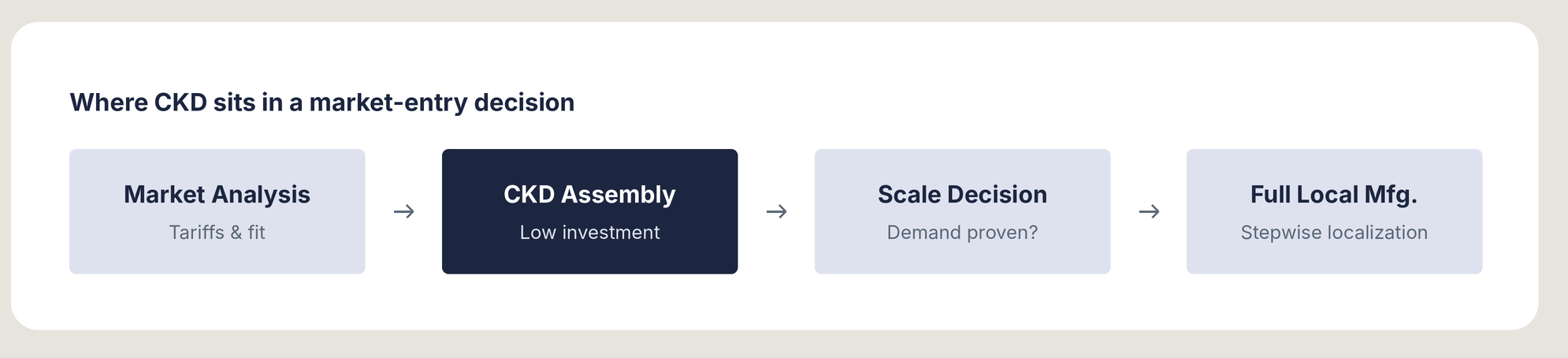
What is CKD?
Required parts and components are packed into kits and shipped to the target market, where they’re assembled locally — manually, in an existing building, without new land or heavy automation.
Western automotive manufacturers have long used CKD to enter promising markets where high tariffs and low volumes made imports or full local manufacturing unprofitable. With trade barriers rising worldwide, the logic now reaches far beyond automotive.
Then and now
From emerging-market entry to a response to new tariff walls
Classic use: emerging markets
In automotive, CKD was traditionally used to enter promising emerging markets, where high import tariffs and limited volumes made imports or full local manufacturing unprofitable.
New use: industrialized countries
Today the same logic increasingly runs the other way too – e.g. Chinese car and truck makers assembling locally to enter the European market, or European manufacturers of complex products setting up operations in the US to work around new import tariffs.
CKD could be the right approach to enable fast implementation with lower upfront investment,
while managing risk and maintaining flexibility for the future.
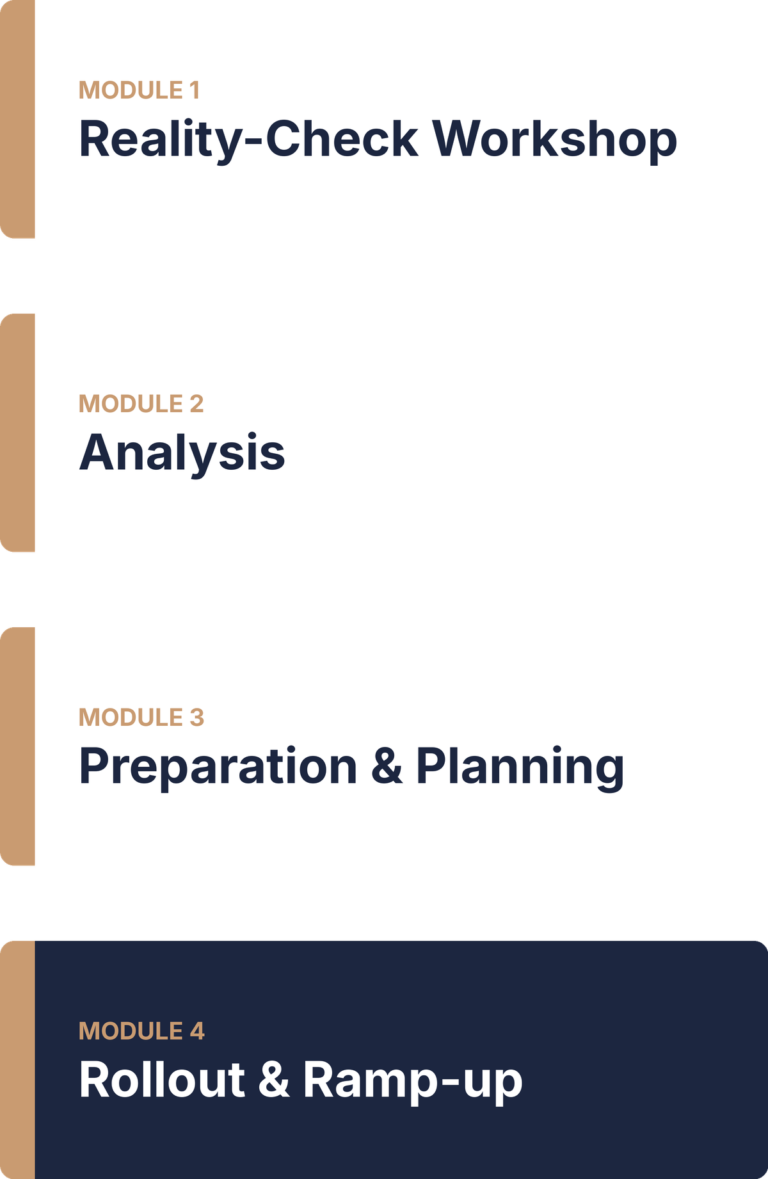
The four-module model
Each module ends with a clear decision point before the next one starts.
MODULE 1: Reality-Check Workshop
- 2 days, on-site or remote
- Product & market fit for CKD
- Go / no-go on basic prerequisites
MODULE 2: Analysis
- Business case & cost calculation
- Tariff regime & import credits
- Supplier & sourcing review
MODULE 3: Preparation & Planning
- Site & production concept
- Logistics & kit-packing design
- Quality & supply chain setup
MODULE 4: Rollout & Ramp-up
- On-the-ground launch support
- Ramp-up & series-quality monitoring
- Handover to local operations
A decision that pays off beyond one market
Once established, tariff analysis, supplier qualification and logistics frameworks can be leveraged for subsequent market entries, reducing time, effort and cost — particularly within shared trade blocs or supplier networks.
Built and scaled CKD operations on three continents
Brazil, the US and CKD sites across Asia — plus four years in China growing local production. Oliver has seen CKD open markets no full-scale plant could justify yet, and what happens when the trade conditions that justified a site change after it’s built.


Success factors
- Map the real driver — tariff regime, trade agreement, or market-access gap
- Evaluate the logistics partner’s capability, not just its capacity
- Plan kit-packing, sequencing and customs documentation before volume ramps up
- Build in redirectability — a manual, low-investment site is easier to repurpose
- Keep leadership attention on the business case as trade conditions shift
Industries with Potential for CKD Implementation
CKD is relevant wherever complex, multi-part products meet trade barriers.
Automotive
The proven origin — still evolving with EVs and new entrants.
Mechanical Engineering
Machines and modules assembled close to the customer.
Construction Machinery
Heavy products where shipping whole units is costly.
Medical Devices
Local presence for market access and regulation.
Robotics
High-value components, final integration locally.
Aviation & Defense
Local content expectations, sensitive supply chains.
What is required
CKD is more than an assembly line
Success depends on the whole system, not only the manufacturing process in the target market.
Kit definition, packing, logistics, customs and origin documentation.
Forecasting, order-to-kit planning and variant management.
Building a supplier base and stepwise localization of content.
Training, processes and standards equal to your home plants.
Lean layout, equipment and people — sized for market volume.
CKD Market Entry Consultants

Oliver Fuchs
Partner
Automotive - Mechanical Engineering - Automation & Robotics - Defense
In addition, I advise companies on executive search and talent-related career solutions. My goal is to be a trusted and long-term partner in developing organizations with the right people — bringing together talent, leadership capability, and deep industry know-how to create lasting impact.
Driven by a passion for international collaboration, I help build powerful global organizations that deliver technologically advanced, sustainable, and high-quality solutions — with the ambition to build strong, future-ready automotive and defense ecosystems.
Disclaimer
The consultants (B&P Partners) featured here operate as independent service providers. Brandt & Partners assumes no responsibility or liability for the accuracy, completeness, or quality of the content displayed, nor for any actions or outcomes resulting from services provided independently by these consultants.